
Nos últimos anos, a comunidade de software livre e de código aberto (FOSS) tem testemunhado debates intensos sobre a implementação de códigos de conduta em projetos.
Enquanto muitos defendem a adoção desses códigos para promover ambientes inclusivos e respeitosos, alguns CoC com textos subjetivos foram usados em casos como pretexto para perseguir, censurar e excluir membros ou impor agendas de grandes empresas que contribuem para os projetos. Com isto, surgiram e ganharam forças iniciativas que questionam sua necessidade, propondo abordagens alternativas.
Pesquisando no github (por tópicos ou pelo arquivo .md do CoC), facilmente encontrará versões no formato “A minimal alternative for other codes of conduct“, sendo reduções para um mínimo aceitável por cada projeto.
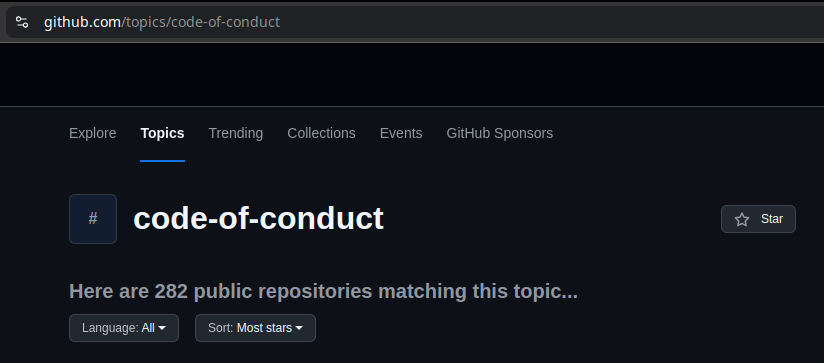
Duas dessas iniciativas são o “No Code of Conduct” e o “Code of Adult Conduct”.
No Code of Conduct
O “No Code of Conduct” é uma proposta que sugere a ausência de um código de conduta formal em projetos de software. Seus defensores argumentam que os participantes são adultos capazes de interagir de maneira madura e profissional, sem a necessidade de diretrizes explícitas sobre comportamento. Eles enfatizam aceitar contribuições de qualquer indivíduo, independentemente de suas características pessoais ou crenças, promovendo um ambiente onde somente a qualidade das contribuições é relevante. Essa abordagem busca evitar debates prolongados sobre comportamentos aceitáveis, focando exclusivamente no desenvolvimento do projeto.
É uma declaração direta e minimalista que reflete a visão de desenvolvedores que preferem evitar regras formais em seus projetos. Ele estabelece que “não haverá código de conduta além do compromisso de não ser um idiota” e que os mantenedores têm total liberdade para banir quem julgarem necessário, sem processos burocráticos ou justificativas detalhadas. A proposta é manter a simplicidade e a autonomia do projeto, evitando o que seus criadores veem como “políticas corporativas” ou “engenharia social”. O texto critica os CoCs tradicionais por, supostamente, priorizarem sentimentos em detrimento da meritocracia e da produtividade, sugerindo que a comunidade FOSS deveria se autorregular com base no bom senso e na liberdade individual.
Conteúdo do No Code of Conduct:
# Contributor Code of Conduct

This project adheres to No Code of Conduct.  We are all adults.  We accept anyone's contributions.  Nothing else matters.

For more information please visit the [No Code of Conduct](https://nocodeofconduct.com) homepage.

## What is No Code of Conduct?

No Code Of Conduct is a groundbreaking new idea. Designed to help you find communities and projects that will not get stuck endlessly debating how members should behave in their communities, only to be found to never be fully resolved to anyone's liking.

#### What if... we all agreed?

1.  We are all adults. Capable of having adult discussions.
2.  We accept everyones contributions, we don't care if you're liberal or conservative, black or white, straight or gay, or anything in between! In fact, we won't bring it up, or ask. We simply do not care.
3.  Nothing else matters!

#### Q: Great! How do I add this to my project?

Simply copy CODE_OF_CONDUCT.md into the root directory of your project. You may modify it to your needs.

#### Q: How do I promote No Code of Conduct?

Feel free to talk about, discuss, and promote No Code of Conduct anywhere you wish, and use the hashtag #NCoC on Twitter.

#### Q: What if, this makes me feel discriminated against?

If you feel this way simply because we do not have a code of conduct, it is hard for anyone to relate to you. This is not intended to discriminate against anyone. Simply because we don't babysit people on our site to make sure they treat you with respect, does not mean we hope you feel unwelcome, or that you are treated without respect. That is just not something we have time for.

#### Q: Without a CoC, how would I possibly feel safe engaging in your community? How would I raise a red flag if I am mistreated?

The way you would go about this in any other discussion forum. If you limit yourself to participating in things that only have codes of conduct, then you're limiting yourself as a human being on this marvelous place we call the internet. It is not this community's place to care about individual feelings. We leave that to the individuals. The internet is a big place, you should prepare yourself to deal with it.

#### Q: If you don't have a CoC, this will surely be the end of your project, and the end of some talented individuals contributing to it!

There is plenty of proof that not having a CoC is a workable solution. While the linux community for example may not be warm and helpful, there is nothing wrong or offensive about it, and you certainly will not be harassed unless you harass people there.

#### Q: What about non-internet communications, such as a place of work, or a conference?

These understandably are different. Often sane communities will have a CoC that is unique to their physical location, and/or event. In different parts of the world, the needs are different (see "he" vs "she" vs "they" vs people that do not have English as their primary language). We are talking about the internet here, not physical meet ups, and that requires we do not care about the unimportant parts of how people talk.

#### Q: Without a CoC, how would this community be welcoming to newcomers, and not become vile, intimidating, or have some other type of unwelcome agenda?

We strive to lead by example. We feel there are enough level-headed adults here to back you up. However, if someone tells you you are stupid, or wrong. Stop. Think. Does this have anything to do with your race, region, religion, or anything else not related to this project? This is a tricky one. Have you considered, that they are either having a bad day, are a bad listener, or possibly, you are wrong? If you feel you're not wrong, please, by all means, reply. We love discussion! We love our members. We are confident if you are a level-headed adult, you will be treated like one. Other level-headed adults want to hear from you.

#### Q: Your name is offensive. CoC sounds like Cock, and I feel that this is a group of white males that is trying to downplay the seriousness of this issue in our community, and I boycott your movement, and am going to tell others to as well!

That wasn't really a question, but we will answer it anyways. This is an example of starting a fire where there does not need to be one. Try to be more tolerant of others and not read into their deep inner views. We have said clearly over and over that we don't care who you are, where you come from, or where you're going. We value intelligent discussion on our topic, and that's it. If you want to not use any community that adopts NCoC, that is fine. But please do listen to the content, and do not read too far in-between the lines. It simply stands for No Code of Conduct.

#### Q: Oh no, it has definitely happened! Someone has treated me unfairly, and I'm 100% sure its related to something about who I am, and not related to what I have said or contributed directly.

Email that person, and try to work it out. Email the owners of the community, and alert them. Whatever you do, do not make a scene, as that will burden the entire community with your issue. If it's truly a problem and you're truly an asset to the community then you will probably get an email back. Sometimes, you have to be the bigger person. Say your piece privately, and don't dwell on it. Remember, this is not the time or place to start these kind of discussions. If someone else did this to you, that is unclassy, but there is only so much a moderator and personal discussion can accomplish. I am afraid that bringing to a larger group will be of poor form, and not helpful.

#### Q: What about off-topic chatter?

Off topic chatter should be discouraged, but not censored. NCoC is targeting things like open source projects and public online communities based around specific topics.

#### Q: How can I contribute to your project or community when I see someone said something on a different site or community which directly makes me feel awful?

We are not in the business of policing people's personal lives. Hopefully they also don't care about that when they are here. Part of not discriminating against people, is not discriminating against people. This is not world court. Sometimes people have different views. Just because they express this elsewhere, doesn't mean we don't care. If you are so stuck that a member of our community does or is something you don't like elsewhere, then you should probably not be here.

#### Q: As a community manager or leader, what happens when the mob arrives, or when someone starts to engage in discussion that could lead to more endless discussion?

Lock, and ban your way to freedom. This is unfortunate. Try to not delete anything, or you will be accused of censorship. But you have no other choice. Do not engage. Abort, abort abort! You should really be very brief, vague, and closed off in these discussions. Say something like: "hey, this is not the place to discuss this, please reach out to each other privately or on another medium to discuss it. This group is strictly about topics relating to $YOUR_TOPIC". End.

#### Q: WTF, the discussion was locked, and/or I can't reply!?

Once again, we are not going to tolerate our community being overridden by the mob. If this starts to happen, we will nuke, delete, lock, close, ban, and do whatever we have to do to put the fire out. These discussions drag on and on and on, and they don't make communities better.

#### Q: Why don't you care about my feelings?

We are not a support group for human emotion. We are a community that strives to focus around our topics. Anything else takes away from that.
Fonte: gist.github.com/Esl1h/2efe217c05a4bb5045deead56f6a8ea0
Code of Adult Conduct
Por outro lado, o “Code of Adult Conduct” propõe princípios como caridade, agência e foco, sem ativismo social ou político, mas com aplicação via avisos e possíveis banimentos.
Uma abordagem satírica e pragmática. Ele se apresenta como um código para “adultos funcionais”, rejeitando a necessidade de regras detalhadas ao afirmar que os participantes devem “agir como adultos” e resolver conflitos diretamente, sem intermediários ou comitês. O documento lista expectativas como “não seja um babaca” e “respeite os outros”, mas enfatiza que não haverá processos formais de denúncia ou punição — se algo der errado, os envolvidos devem “se acertar ou sair”. Essa proposta reflete uma crítica aos CoCs extensos, que, segundo seus defensores, infantilizam os contribuidores e criam uma cultura de vigilância em vez de colaboração.
A “caridade” incentiva os participantes a presumirem boas intenções nas interações, evitando mal-entendido.
A “agência” destaca a responsabilidade individual sobre as próprias reações emocionais, sugerindo que ninguém pode “ferir” os sentimentos de outra pessoa sem seu consentimento.
O “foco” orienta que discussões políticas ou sociais sejam evitadas no contexto do projeto, mantendo a atenção no sucesso do desenvolvimento do software. Mecanismos de aplicação incluem advertências seguidas de banimentos temporários ou permanentes para minimizar distrações.
# Code of Adult Conduct

## 1. Principle of Charity

When interacting with people around this project try to assume the best of them. If something seems offensive start by assuming you've misunderstood. Treat others as you would wish them to treat you.

## 2. Principle of Agency

We all possess the capacity to chose how we feel as well as how we react. Other people cannot "make" you feel bad or "hurt" your feelings unless you allow them to. Choose to take responsibility for your own mental state and exercise your agency. Do not give other people power over you that they do not have; the power to trigger you. You have the ability to ignore most anything. Use it.

## 3. Principle of Focus

This is not the place for social or political activism. When interacting with people around this project keep it on topic. While here, the only cause you should be fighting for is the project's success. No distractions.

## Enforcement

Warnings followed swiftly by temporary or permanent bans to minimize disruption to the focus on the meritocratic project of software development.

##### Source
Author: Not Governor
URL: https://gitbanned.com/NotGovernor/Code_of_Adult_Conduct/src/branch/master/README.md
Fonte: gist.github.com/Esl1h/8b72913111079d264d24570245e61f96
Conclusão?
Independentemente da corrupção causada na mente dos que ganham poderes privilegiados na administração das comunidades e projetos FOSS, e a usam para perseguir quaisquer divergentes as suas ideologias pessoais, é preciso um código para nortear as discussões em prol do objetivo do projeto ou comunidade, visando a melhoria do programa.
A aceitação desses movimentos na comunidade open source é limitada e polarizada. Projetos que adotam o “No Code of Conduct” ou o “Code of Adult Conduct” tendem a atrair desenvolvedores que valorizam a liberdade irrestrita e desconfiam de estruturas formais, mas enfrentam resistência de uma parcela significativa da comunidade que vê esses manifestos como imaturos ou insuficientes para lidar com problemas reais, como assédio ou discriminação.
Dados concretos sobre adoção são escassos, mas a presença desses movimentos é mais sentida em discussões online (como no X ou em fóruns) do que em projetos mainstreams, que frequentemente optam por CoCs estabelecidos, como o Contributor Covenant (provavelmente, o mais usado!).
Por outro lado, a defesa de códigos de conduta tradicionais argumenta que eles são essenciais para criar ambientes inclusivos, proteger contribuidores vulneráveis e garantir que o FOSS seja acessível a todos, não somente a quem já está confortável em uma cultura “sem regras”. Assim, enquanto os movimentos contrários têm seu nicho, a tendência majoritária ainda favorece a formalização de normas para sustentar comunidades diversas e sustentáveis.
Críticos argumentam que a ausência de um código de conduta formal pode levar à falta de clareza sobre comportamentos aceitáveis, potencialmente resultando em ambientes hostis ou exclusivos. Eles defendem que códigos de conduta estabelecem expectativas claras, promovem a inclusão e fornecem mecanismos para lidar com comportamentos inadequados, contribuindo para comunidades mais saudáveis e produtivas.
Estou provocando a discussão, e não concluindo nada! Mas se chegamos ao ponto de propor tais abolições, significa serem tão grandes os desvios que culminaram nestas reações. Fica a reflexão.
https://www.contributor-covenant.org/
https://opensource.guide/code-of-conduct/
https://github.com/topics/code-of-conduct
https://stackoverflow.com/conduct
https://hashnode.com/code-of-conduct